Jathedar SantokhSingh
ਜਥੇਦਾਰ ਸੰਤੋਖ ਸਿੰਘ
20 March 192921 December 1981
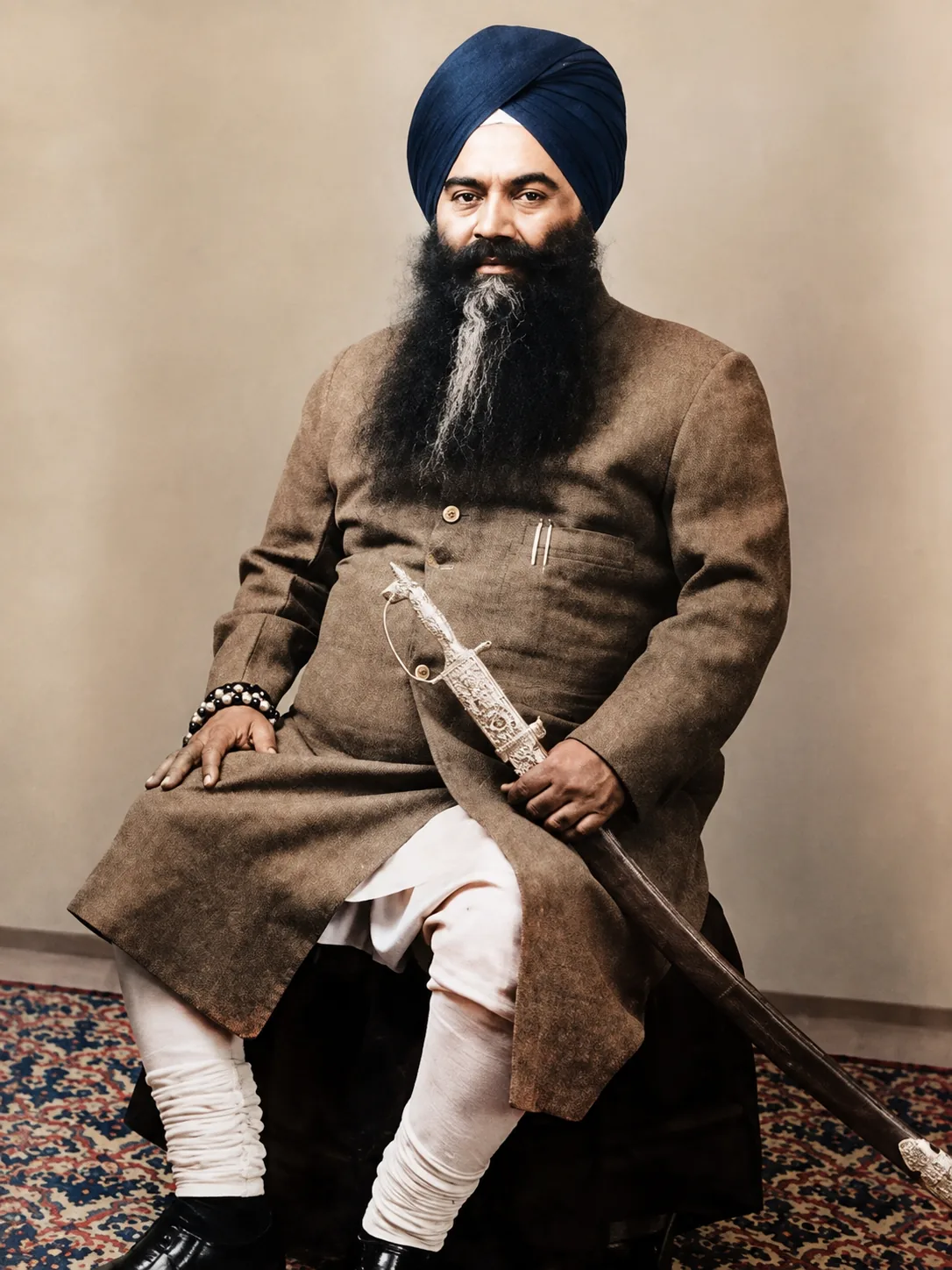
President of the Delhi Sikh Gurdwara Management Committee. Recovered the Kotwali at Chandni Chowk — where Guru Tegh Bahadur was held before his execution — for the Sikh community, 1968. Among the founders of Guru Harkrishan Public School, 1965, and Mata Sundri College for Women, 1967.
i. Biography
A Sikh leader in Delhi, active in the administration of the capital's gurdwaras and in the organisation of Sikh political activity in India and Britain.
Kot Badal Khan 1929–1942
Jathedar Santokh Singh was born at Kot Badal Khan, in Jalandhar district, on 20 March 1929. He was not given that name until he was twelve or thirteen years old.
The family had come from Kartarpur, the town Guru Arjan Dev established in the Doaba, nine or ten kilometres from Jalandhar, where they held twelve wells' worth of land and farmed it. His father, Sardar Buta Singh, had little taste for agriculture and a strong inclination toward trade; after visiting the surrounding villages and consulting people who knew the district, he settled on Kot Badal Khan — then a village of some four thousand, with a prosperous and politically influential Pathan Muslim population largely associated with the Muslim League.1
Buta Singh had been there about ten years when his wife bore their son. At forty days the parents carried the child to the village pandit, Ram Krishan, who named him Ram Lubhaya and told them what the boy would become: he would not go far in school, his mind would carry him past men with degrees, he would become a leader, he would go to prison, and at his death half the world would walk with him.2
Ram Lubhaya was the eldest. Several brothers and sisters died young; four brothers and two sisters reached adulthood — Harbhajan Singh, Sohan Lal, Mohan Singh, and Surinder Singh, and the sisters Bhagwanti, known as Bhago, and Sohan Devi. Harbhajan Singh would support his political work in its early years.
The village had two schools: one for girls through the eighth class, one for boys through the fifth. Ram Lubhaya took his primary education there and was fond of Master Telu Ram, who lived nearby — a teacher he made a point of visiting whenever he returned from Delhi, for the rest of his life. After the fifth class he was enrolled at Nurmahal. He was a capable student, and represented his primary school at the scholarship examination in Phillaur. The journey there was his first time on a train.3
The extended family included both Sikhs and Sehajdharis. A sadhu lived at the village dharamsala, and the boy went often to listen and to talk with him about religion. He attended recitations of the Gita and had memorised many of its verses by the third or fourth class; his voice was strong and his pronunciation exact, and when the sadhu was called away he left Ram Lubhaya to read to the women who gathered in the afternoon.
In time his attention turned to the village gurdwara. Taken by his father to Dera Baba Wadbhag Singh to have his hair cut, he refused. At about twelve or thirteen he received amrit, and Ram Lubhaya became Santokh Singh.4
The apprenticeship 1942–1945
The trade he learned in the next three years was chosen for him, and it was chosen because of politics.
When the call of Quit India went out in 1942, Santokh Singh and other students discussed setting off a bomb outside the village. The authorities learned of it, and the boys were released with an admonishment; their fathers kept them under watch afterward. Buta Singh withdrew his son from school, judging that a boy without a trade would only be drawn further in.5
He was sent instead to relatives who kept a cloth shop and a tailoring business, and there he trained in cutting and sewing. He took on the smallest tasks and helped with every kind of household work, set on being taught thoroughly. In five or six months he was proficient. He returned home at about sixteen.
That apprenticeship he spoke about only much later, to his youngest son: hard masters, a whip scar he still carried, water fetched from a canal, every household chore loaded onto him before he was let go for the day.6
In 1945 his father arranged his marriage to Bibi Satya Kaur of Bagrian, daughter of Sardar Hazura Singh and Gurdev Kaur. She had not attended school; at Chak Bagrian she learned Punjabi from Harbans Kaur, daughter of Rattan Singh Akali, and could read from the Guru Granth Sahib, perform its prakash, and carry out the nightly sukhasan.7
Lahore 1946–1947
He went to Lahore as a tailor and left it as an Akali.
Tailoring would find a larger market in a city, and his father wanted him out of the village. Santokh Singh went to Lahore and rented a shop in Dharampura, near Gurdwara Sri Guru Singh Sabha. Satya Kaur remained with her parents, as was customary, and came to him about two years after the marriage.
Living alone, his expenses were small. He did not drink; he ate neither eggs nor meat. He worked through the day and listened to kirtan at night, rose at amrit vela, completed nitnem, and went house to house to bring the sangat together. At the Dharampura gurdwara he did extensive seva, and led prabhat pheris on gurpurabs. People began bringing him their problems.
Lahore also brought him to the Akalis, whose freeing of the gurdwaras from the mahants he had heard about since childhood. Dharampura was a Congress stronghold. In the 1946 provincial election Santokh Singh planted the Akali flag over his own shop and turned it into an election office.8 Congress workers tried to have his tenancy ended. The owner, Teja Singh, came to see the young tenant, approved of what he was doing, and told him not to worry about the rent in a hard month.
When a Congress leader stood near a shop abusing Akali leaders, he confronted the man so forcefully that he left. When Master Tara Singh came to Dharampura he was pleased with the young worker, and told him:
Son, do not worry. Work with all your strength, and if anything is lacking, come to me without hesitation. Do not forget.9
The Shiromani Gurdwara Parbandhak Committee election came the same year. The Akali Dal put up Bakshish Singh of Dharampura against the influential Amar Singh, and Amar Singh's influence did not hold against the campaigning. Bakshish Singh won. Santokh Singh sought nothing for himself. He was not at that point even a member of the Shiromani Akali Dal.
Partition 1947
What he had built in Lahore lasted a year and a half. The city went to Pakistan, and there was no staying in it. He came home.
Hindus and Sikhs were few in Kot Badal Khan, and the family's account records repeated attempts on his life there, all of which failed. During the communal violence around Nurmahal Santokh Singh organised the Sikh youth of the district, brought exposed families to safety, planned the defence of the gathered population, and stayed at it until the crisis passed.10
Delhi 1948–1952
Delhi did not know him when he arrived. It knew him within two years.
Santokh Singh reached Delhi on 7 January 1948 and began business on Nai Sarak.11 He was later allotted a small premises on Hamilton Road, where he continued the military tailoring he had practised in Lahore. He worked long days at the shop and spent his evenings in seva at Gurdwara Sis Ganj Sahib. The household near Kashmere Gate filled with Panthic discussion, and their eldest son, Tajinder Singh, was born in these first Delhi years.
His first conspicuous intervention in the city's Sikh politics came at a gathering at Gandhi Ground, when Punjab minister Ishar Singh Majhail spoke of Master Tara Singh in objectionable terms. Santokh Singh answered with slogans; others rose with him, and the meeting broke up in disorder. He was new to the city and almost unknown.12
At the end of 1949 the Akali Dal planned a conference at Rakab Ganj Sahib. The government banned it and arrested Master Tara Singh at Narela station, and the political gathering became a martyrdom conference instead. The slogans Santokh Singh raised there drew the notice of senior leaders. After that conference he did not need introduction among Delhi's Sikhs.13
In 1951 Santokh Singh became head of the Chandni Chowk Akali jatha. His partnership with Avtar Singh Kohli, begun about then, would become one of the defining relationships of Delhi Akali politics — Kohli said later that the thirty-year history of the Delhi Akali Dal and Santokh Singh's work were a single fabric.14 In the 1952 Punjab elections he led a Delhi team campaigning for Akali candidates and raised funds for them. That became the pattern for the rest of his life: Delhi sent workers and money to Punjab for every election and every major morcha.
Ferozepur 1955–1962
A jail sentence he could have cut short made his standing in the Panth.
In 1955 the government banned the slogan Punjabi Suba Zindabad. Santokh Singh sent two Delhi jathas and led a third himself.
Police raided Guru Ram Das Sarai on the night of 3–4 July. The Delhi jatha resisted arrest inside the complex, prayed at the Akal Takht in the morning, and presented itself publicly outside the Darbar Sahib. He was imprisoned at Ferozepur, where some 2,200 Akalis were being held, and where he met Sant Fateh Singh for the first time. He took responsibility inside for organisation and the distribution of supplies.
The agitation ended on 12 July, and men began to be released. Santokh Singh was not, because he would not give a false statement to obtain it. Before the magistrate he admitted openly that he had broken Section 144 and raised the slogans, and he served the sentence out.15
He put the case of Delhi's Punjabis for a Punjabi-speaking state to the commission that followed. When it accepted linguistic reorganisation elsewhere and refused it for Punjab, he led a Delhi protest against the decision. For the Akali conference at Amritsar in 1956 he brought fifteen busloads from Delhi, besides cars and other vehicles, and the Delhi Akali Dal contributed ₹21,000.
That year the Delhi Akali Dal chose him its jathedar, unanimously, and he entered the Shiromani Akali Dal working committee. He was twenty-seven. The title stayed attached to his name for the rest of his life and beyond it.
He held the Delhi office three years and resigned it on 22 February 1959, after differences with the high command.16 He had already convened a Delhi procession in February 1958, after desecrations of the Guru Granth Sahib in Punjab, and another followed in March 1959. Elected to the Gurdwara Management Committee, Delhi State, for the first time in 1959, he sat on it until September 1961. A new committee was formed in April 1962. When its secretary resigned for reasons of health that October, Santokh Singh was elected in his place, unanimously, on 10 October 1962.17
Secretary 1962–1971
The title understates the position.
Santokh Singh held it for nine years, and everything the committee is now remembered for was done inside them: the Kotwali recovered for Sis Ganj Sahib, the land around Bangla Sahib, the schools, the recovery of gurdwara property across the city. He served under two presidents, Bakshi Gurbachan Singh and Giani Singh Abbottabadi. It was he who petitioned the Lieutenant Governor, he whom the sangat garlanded when the Kotwali was won, and he to whom six organisations addressed formal tributes between 1968 and 1977 — while other men held the presidency.18 One contributor, writing of these nine years, called them a golden period in the history of Delhi's gurdwaras.
The work began with the files. A detailed examination of committee records turned up houses, mills, factories, and private allotments sitting on gurdwara land, in some cases for decades. Santokh Singh set about regularising title and recovering what had been taken.
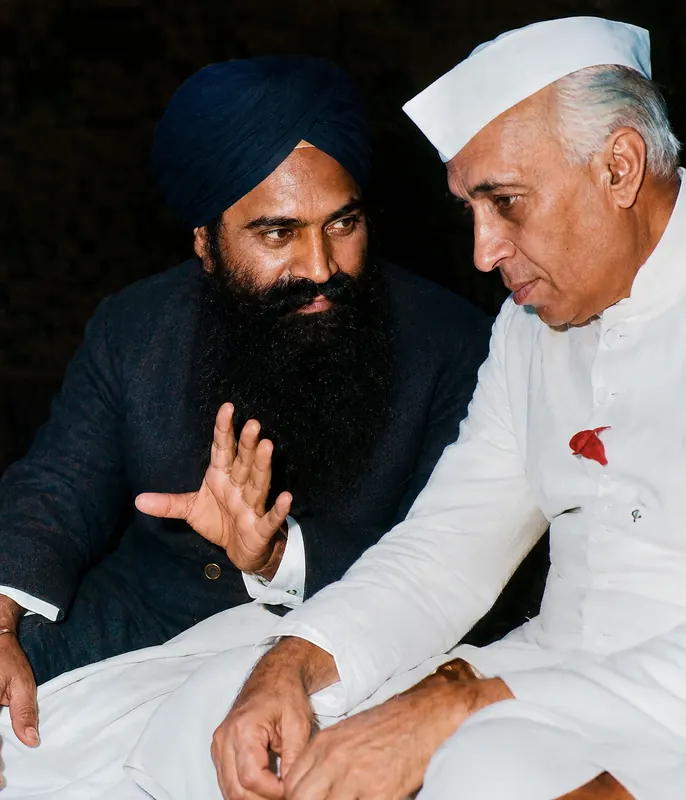
Mata Sundri. When he started a boundary wall in 1962 to stop further encroachment, officials objected that only the footprint of the gurdwara building belonged to it. The dispute went up to the Prime Minister. Officials produced a map marking the building alone as gurdwara property and everything out to the roads as government land. Santokh Singh asked one question: if the map were right, by what road did worshippers reach the gurdwara — did they fly across someone else's land? A valid map would have shown an access road. Nehru accepted the argument and ruled that the open land up to the road belonged to the gurdwara.19
Then he went back for more. A property case lost in 1924 was reopened and carried to the central government; the western ground, the boundary wall, the site for Mata Sundri College and later another three and a half acres for its expansion all followed.
Bangla Sahib had almost no room to grow. A valuable side plot beside it had been made over by cabinet decision to the yoga ashram of Dhirendra Brahmachari, who taught Indira Gandhi. Santokh Singh refused it, took the ground, and held it until the cabinet reversed itself and the registry was put in the gurdwara's name. His son dates the beginning of the quarrel with Indira Gandhi to that plot, in 1969.20 He obtained municipal closure of the road in front, which created the divan space and the approach the gurdwara has now. When the western barracks were allotted elsewhere, committee leaders occupied them and began an indefinite dharna until the government reversed the allotment, joining the land as far as Gole Dak Khana to the shrine. Baba Harbans Singh's jatha then did the kar seva for the sarovar.
Rakab Ganj. About two and a quarter acres of long-standing occupation were regularised and another eleven recovered, bringing the estate to roughly thirteen acres. On 17 January 1967 Master Tara Singh laid a foundation stone there for a Guru Gobind Singh Bhavan, a thousand-seat auditorium, a central library, a Sikh museum and study rooms, on plans by the architects Joseph Allen Stein and P. L. Varma.
Five other shrines were taken in hand in the same years.
Moti Bagh had been reduced by houses, shops, a flour mill and factories to a single room beside a public path where people stood smoking. The encroachments were removed and the path brought under control. When the ring road was widened in 1975 the alignment would have taken the site; he had a boundary wall built and would not move it, and the road still halts at the wall and picks up beyond it.21 Damdama Sahib, hemmed between Humayun's Tomb and the railway, had almost no recognised land; he obtained the surrounding property.
At Majnu ka Tilla the Yamuna was carrying away the bank, and the committee spent heavily on protective spurs against litigation from self-styled mahants. At Nanak Piao he had the seasonal drain redirected and covered, opening ground around the shrine, and later obtained another seven acres. At Bala Sahib, land was raised and recovered against the floods.
The Kotwali 1968
The claim began in his own mind, before either the committee or the wider community believed it could be won.
The building stood beside Gurdwara Sis Ganj Sahib in Chandni Chowk. Guru Tegh Bahadur had been held there before his execution; so had Bhai Mati Das, Bhai Sati Das and Bhai Dayala, and later the 740 Sikhs taken with Baba Banda Singh Bahadur. It had been in other hands for close to three centuries. Others had scarcely dared name the claim.
What started it was a nail. Crowds coming to see the historic shastars returned from Britain were reaching the well associated with Guru Tegh Bahadur's last bath through a narrow lane beside the Kotwali, and sevadars began fitting a gate to manage the crush. They drove one nail into the Kotwali wall, in 1966, and the station house officer arrested them.22 Santokh Singh came to the police station and said:
For one nail in that wall you have seized my men. Now we will take the Kotwali itself — the place where Guru Tegh Bahadur was held before martyrdom and where Banda Singh Bahadur's Sikhs were imprisoned. It is Sikh history, and we will recover it.23
Santokh Singh acted alone at first. He wrote to the Lieutenant Governor of Delhi, Aditya Nath Jha, and met him on 3 February 1968 with historical material showing what the building was. Jha accepted the case. Santokh Singh judged that an announcement from himself would be dismissed as wishful thinking, and asked the Lieutenant Governor to make it instead. On 2 May 1968, presiding over a school prize-giving at Dev Nagar, Jha announced that the Kotwali would be given to the gurdwara. Only then did the wider community believe it possible. The committee passed its first resolution that September.
A preliminary ceremony was set for 2 October and could not proceed: opponents raised legal and departmental objections and proposed payment for only half the property. Santokh Singh consulted his colleagues and issued an ultimatum — unless implementation began by 13 October, the community would take direct action and make whatever sacrifice was required. The obstacles fell. More than six thousand square yards, about eighty per cent of the Kotwali, were assigned to the committee for ₹1,635,000. Jha laid the commemorative stone on 11 October 1968 and handed over two barracks that day. Further possession followed in November 1969 and February 1970. When Sikhs protested that the government had charged them for a memorial, the Government of India announced that the money would be returned.
More passed to the committee on 26 November 1976. The last portion was handed over on 14 June 1983, eighteen months after his death.
The schools 1965–1975
The other half of the work was schools, and it started with his own children being turned away.
Two of his sons had been enrolled at St Xavier's. The administrators told him the boys could not stay, because their parents did not speak English. A sympathetic figure at the school disclosed the other reason: Sikh boys there sometimes cut their hair and took up smoking, and the school was afraid that if this happened to Santokh Singh's sons he would arrive with an army of Nihangs.24
Guru Harkrishan Public School opened at India Gate in 1965. The first premises on Purana Qila Road were rented at ₹6,000 a month. He enrolled his own children on the first day, then drove to a friend's house, collected their children, and enrolled them too; when the father objected that a new school might fail, he answered: Why should it not run? We will work, and we will appoint good principals.25 Within three or four years it was competing with Delhi's established public schools. By his death there were ten.
Santokh Singh paid teachers above the government grades to get the ones he wanted. When a new principal arrived on a scooter, he told him to come by that evening — I am going to get you a car. I do not want the principal of my school to be regarded as less than the principal of any other school.26 He appointed without regard to caste or community, and the principal he chose for India Gate, Mrs Sengupta, was neither Punjabi nor Sikh.
His own children got no benefit from any of it. When Manjit was late for school his father telephoned the principal himself: My nawab is arriving late. Give him the same punishment as every other child. The boy was made to stand at the gate, and was caned more than once.27
Mata Sundri College for Women was established beside the gurdwara in 1967, on land he had spent five years recovering. His youngest son remembered the meeting where it was secured — a guard at Teen Murti announcing the fighting Sardar has come, and Nehru objecting that Sikhs wanted nothing but gurdwaras. Santokh Singh said the land was for a women's college. Nehru put down his pen. You want to educate our mothers? You will have the land.28 Getting the land was one fight and getting permission another: the Delhi Master Plan confined new university colleges to the northern and southern campuses, and his argument for a central site was that students drawn from every quarter of the city should be able to reach home before dark. Something over eight thousand women now study on the ground, counting the college's own students together with those of the University's non-collegiate board.29
He served two terms as the college's chairman, from 13 July 1967 to 2 June 1970 and from 11 September 1970 to 23 July 1971.30
A second Guru Harkrishan Public School opened at Vasant Vihar in 1975 on 9.75 acres provided by the Delhi administration. Sri Guru Tegh Bahadur Khalsa College began as an evening college in the Dev Nagar building. A technical institute was raised on land beside a gurdwara. A government senior secondary school was established in the Sis Ganj area with free admission; more than eighty per cent of its later pupils were girls from Muslim families.
He had left school after the sixth class.
Beyond Delhi 1964–1969
Sikhs elsewhere brought him their problems, and the pattern of his response was consistent: go, see it, then use Delhi.
After police firing at Paonta Sahib on 22 May 1964 killed eleven Nihang Sikhs, he visited the wounded first and then arrived with a large Delhi jatha. He helped build an eleven-member management committee for the shrine afterward, fought in court to recover roughly seven hundred bighas alienated by the mahant, and supported the survivors' families. The shrine then took five or six hundred rupees a month in offerings; he sent Delhi sangats by the busload and pressed principals to hold student camps there.31
When attackers tried to burn Gurdwara Bagmari in Calcutta in 1967, he travelled there with Avtar Singh Kohli and others to see it, came back, and led eleven people in a hunger strike outside Bangla Sahib. The Bengal chief minister, Ajoy Mukherjee, came to Delhi with Humayun Kabir, promised an inquiry, and expressed regret; his son recalls Jyoti Basu, then the state's home minister, coming to Bangla Sahib with him.32
In the Terai he repeatedly opposed attempts to displace Sikh and Punjabi farmers. Families who had come from Punjab after Partition had bought scrub and jungle cheaply at Bazpur, Kichha, Rudrapur, Kashipur and Khatima — an acre sold in Punjab bought several in the foothills — and had cleared it into farmland. Twice, once under Nehru and once under Indira Gandhi, the government moved to return the holdings to those who had sold them. His son says the army was called out on both occasions and sent back to barracks both times, and the families stayed.33 The U.P. Sikh Representative Board made him its director for Sikh issues at Lakhimpur in 1969, and renewed it at Lucknow after.
In Britain there were two campaigns, and he acted in both.
Manchester Corporation had refused since 1960 to let turbaned Sikhs work as bus conductors. Santokh Singh pressed the Government of India to intervene and organised a Delhi action on 6 April 1966; the Manchester transport committee voted to lift the ban that October, 71 to 23.34
The second began in June 1967, when Tarsem Singh Sandhu returned to his job as a Wolverhampton bus driver wearing a turban and a newly grown beard and was sent home without pay. Santokh Singh organised a march to the British High Commission in Delhi in solidarity with him; the historical record puts attendance at 50,000. In 1968 he convened a conference at Birmingham to bring Britain's Sikh organisations under one umbrella, and there he brought four divided groups into a common body. Sohan Singh Jolly, president of the Shiromani Akali Dal in Britain, announced in January 1969 that he would burn himself alive on 30 April if the ban stood. Wolverhampton lifted it that April.35
After the 1965 war, Prime Minister Lal Bahadur Shastri sent for him. Shastri took him to an army hospital and stood beside a Sikh soldier who had lost both legs attacking a tank, and who was weeping. Asked why, after such courage, the soldier said: The prime minister of my country stands before me, and I cannot rise to salute him. Shastri told Santokh Singh he wanted to do something for the Sikhs. Santokh Singh asked for the return of Guru Gobind Singh Ji's historic shastars, held in Britain. The Prime Minister wrote to the British government, and the shastars came back within his lifetime; the two men helped carry them off the aircraft at Palam themselves.36
Seventeen days 1971
Nine years of it ended in a locked gate.
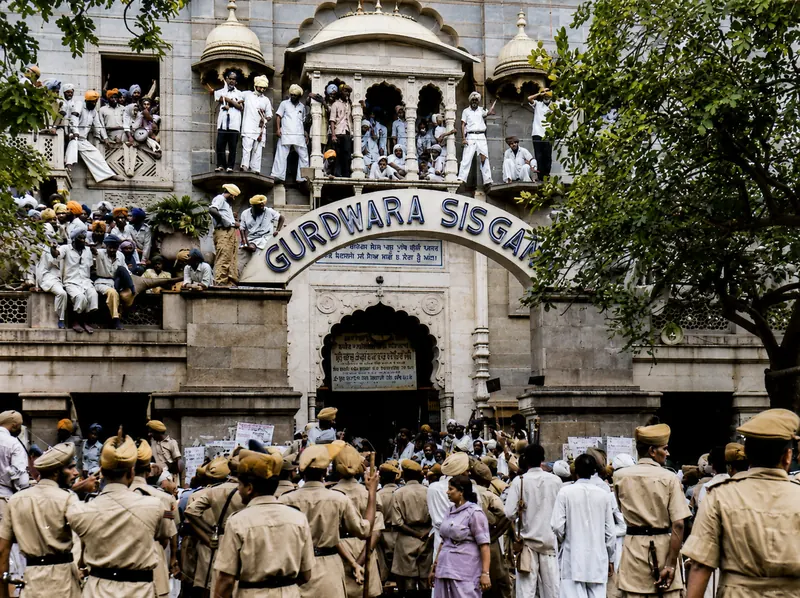
On 5 May 1971, hostile forces took Gurdwara Sis Ganj Sahib, where the committee kept its office, locked the main gate and held the premises for seventeen days. The Delhi High Court ordered the committee dissolved and fresh elections held. On 20 May the Government of India issued an ordinance and installed a five-member interim board. Control of the gurdwara had passed to Nirlep Kaur, with government and court support.
The Akali Dal began a morcha in Delhi to recover it, with twenty thousand workers. Santokh Singh was its moving spirit. He was imprisoned with other leaders on 15 August and held for nearly four months, released on 3 December as conditions changed with the war.37
His opponents said his authority was broken beyond repair.
Barred from office 1975–1977
The first elections under the new Delhi Sikh Gurdwaras Act were held in 1975. His Akali slate won a record victory.
The Act carried an educational qualification. Section 10 provides that no person is eligible for election as President or other office-bearer unless he is at least a matriculate, has passed the Higher Secondary examination, is a Giani, or holds an equivalent qualification.38
He had left school after the sixth class.
Barred from holding formal office, he was chosen party leader by the elected members, unanimously, who said that no other political guide held their confidence.39 He ran the committee for the rest of his life without ever being eligible to head it. His son puts the clause down to Indira Gandhi and says its purpose was to finish him; it was removed by ordinance in 1980, after her return to office, and he was elected president in June 1981, six months before he was killed.40
A critic stated the absurdity most sharply. Sardar Kapur Singh, who opened his own contribution by stating plainly that he was neither a devotee nor a political supporter and that their personal relations had not lately been warm, asked why a qualification demanded of no president, prime minister or minister of the country should be demanded of a gurdwara secretary.41
During the Emergency he consulted senior Akalis, arranged meetings with Indira Gandhi, obtained agreement around a charter of Sikh and Punjab demands, and announced support for her government. Party leaders afterward expelled him for indiscipline, expecting him to collapse without them. Receptions were organised for him across Punjab and India instead.
After Master Tara Singh's death, Santokh Singh took up the leadership of the Bir Khalsa Dal as its Sardar-e-Azam, and set about reviving its scattered units.
The addresses 1968–1977
What his contemporaries thought he had done survives in six formal addresses of honour.
Delhi youth at Mori Gate on 30 June 1968; Gurdwara Akal Bunga Sahib at Ludhiana on 20 September 1970, alongside the SGPC president; the Greater Kailash sangat after the 1975 victory; the Jhelum Gazette fraternity on 21 October 1976; the U.P. Sikh Representative Board on 31 October 1976; the Sikh Association at Chandigarh on 6 January 1977, for twenty-five years of service.
What they credit him with is the estate: the Kotwali, Bangla Sahib's park, Alexander Chambers, the land at Rakab Ganj, Moti Bagh, Damdama Sahib, Nanak Piao, Majnu ka Tilla. And they credit him with Delhi itself — with making it the place Sikhs turned to when there was trouble in England, South Africa, Calcutta or Hazur Sahib.42
At the centre 1980
For a year he had the ear of the Prime Minister, and he used it.
The January general election returned Indira Gandhi to office, and she came to his home to thank him.
Santokh Singh put the case for Darbara Singh as Chief Minister of Punjab to her directly; Darbara Singh was sworn in on 6 June 1980. His son said he could approach her with unusual directness, and that the relationship combined closeness with mutual respect.43
Late that year, at a conference in Jalandhar, he delivered an address as party president that reads now as a political testament. It opened by naming the ground — Jalandhar, the land of the Babbar Akalis. It warned that the danger to the Panth came from within as much as from outside: atheism among the young, proliferating personality cults, institutional failure, decline in gurdwara administration. It recalled the founding of the Shiromani Akali Dal before the Akal Takht on 14 December 1920 and argued that the party had fallen away from that inheritance through division.
Then it set out what he wanted. Protection of Sikh identity first. Open access to the historic gurdwaras left across the border in 1947, and Panthic participation in their management. That the proportion of Sikhs in the armed forces not fall below what it had been at Partition. Defence of Sikh farmers' lands in Haryana, Rajasthan and Uttar Pradesh; Punjabi recognised as a second official language in six states and Delhi. Chandigarh, Bhakra, and the Punjabi-speaking territories, with the village as the unit of linguistic determination. A dedicated transmitter for uninterrupted kirtan from the Darbar Sahib. Fair crop prices, through an All-India Akali Kisan Dal, with separate organisations for women, students and workers.
We do not wish to take another's right, but we will not surrender our own.44
Khiala 1981
In his last year he went, repeatedly, to the places he was warned away from.
Opponents brought eleven or twelve allegations against him at the Akal Takht. He was strongly advised not to appear. He had already boarded the Frontier Mail when a message reached him through the railway telling him to turn back — Lala Jagat Narain had been killed and Punjab was dangerous. He went on, and presented himself.45
Santokh Singh was among the Sikh leaders at Chowk Mehta on 20 September when Sant Jarnail Singh Bhindranwale surrendered, and outside Central Jail, Ferozepur, on 15 October when he was released. The Hindustan Times reported him there as Delhi Gurdwara Parbandhak Committee president, telling reporters at the jail that it was his effort at Delhi that had secured the release.46
On 19 December a family friend, an amateur astrologer, warned him to avoid public appearances for two months. He answered: Do not make me a coward. What is destined for Santokh Singh will strike Santokh Singh. Told to think of his young family, he said: You are here; all of you will look after them.47
On the morning of 21 December 1981 he came back from his walk as the household was sitting down to tea. Manjit's marriage had been arranged for 31 January, forty days off. He sent for an elderly relative and gave him cloth for four suits and two cream-coloured turbans for the wedding. As the man left, he wondered aloud whether his health would let him wear the clothes himself.48
That night he spoke at the gurdwara at Khiala. He was shot as he came out into the lane, hit three times, at point-blank range. His bodyguard, Dhanna Singh, shot the attacker, who died too. The bodyguard himself survived.49 He was fifty-two.
He was president of the Delhi Sikh Gurdwara Management Committee at his death. The wire report filed the following day described the assailant as a former follower of his who had turned against him.50
The police commissioner telephoned the house after eight. The three elder sons left at once; the youngest came back from hockey to find the household in uproar and went with his mother to the All India Institute of Medical Sciences, where Indira Gandhi, Giani Zail Singh and Rajiv Gandhi had already arrived. The police needed the bloodied clothes for the investigation and asked the family to bring clean ones. The youngest son and a friend brought a kurta-pyjama and, with great difficulty, changed the clothes on his father's body. He was unable to speak or cry for four days.51
The cremation was at Nigambodh Ghat on 22 December. Indira Gandhi came, with Buta Singh, Giani Zail Singh, Darbara Singh, cabinet ministers, senior Akali leaders and an immense crowd; when the congestion stopped the family moving, Rajiv Gandhi went to them himself. She returned to the house on 23 December. The ashes went to Kiratpur Sahib in a procession of 125 buses and hundreds of cars, with state honours from Delhi, Haryana and Punjab, and Harchand Singh Longowal and Jarnail Singh Bhindranwale were there. On 3 January 1982 the bhog of the Akhand Paath was held at the house, and the final ardas at Gurdwara Rakab Ganj Sahib.
His brother Surinder Singh had died in 1977, and Santokh Singh had taken in the widow and three children; the two families had lived as one for four years, and would go on doing so for seven more under Satya Kaur's care. The household never described itself as four brothers. It always said seven. After the killing, Satya Kaur said to Surinder's son:
Your father did not die in 1977. He died today, in 1981.52
The family came out of it badly. The businesses failed, the bank entanglements ran for years, and it was 1999 before they were clear. Manjit Singh, who became president of the Delhi Sikh Gurdwara Management Committee in 2013, said there had been no comparable leader since: What he did for the community, the gurdwaras, and the schools — I am only walking in the footprints he left.53
ii. Videos
-
i His own speech
Santokh Singh speaks on the martyrdom day of Guru Tegh Bahadur Ji, honoring his sacrifice and calling for greater public recognition of his legacy in Delhi. In a powerful address to the Khalsa, he urges the community to seek institutions and memorials in Guru Tegh Bahadur Ji’s name.
Posted by Manjit Singh GK · Watch on YouTube
-
ii A short documentary on his life
An archival presentation of Jathedar Santokh Singh on Chardikla Time TV.
Chardikla Time TV, posted by Manjit Singh GK · Watch on YouTube
-
iii An account of a threat on his life
An interview with his son Manjit Singh GK about the killing of his father, which he calls a political assassination, and about the CBI inquiry he says Indira Gandhi promised the family and that never brought anyone to justice. He also recalls Giani Zail Singh being unwilling to attend the bhog if Sant Jarnail Singh Bhindranwale was invited, and answers the allegations made against his father in his lifetime by pointing out that he left no house, office or property of his own.
Auzar TV, interview by Jagseer Singh Buckan · Watch on YouTube
-
iv The demonstration over the turban ban
British municipal bus companies required a uniform cap and a clean shave, which shut observant Sikhs out of the work: Manchester Corporation had refused turbaned conductors since 1960, and in 1967 Wolverhampton sent the driver Tarsem Singh Sandhu home without pay for coming back to his route in a turban and a newly grown beard. This is the Delhi march organised in answer to it, filmed by AP on 7 April 1969 — the same month Wolverhampton gave way, and three weeks before the deadline Sohan Singh Jolly had set to burn himself alive if the ban stood. The placards read in English, for the building they were carried to. AP's caption says embassy; Commonwealth countries exchange High Commissions. Both campaigns are in the biography above.
Posted by AP Archive · Watch on YouTube
-
v He brings Guru Gobind Singh Ji’s shastars home, 1965
Guru Gobind Singh Ji's shastars coming home. Jathedar Santokh Singh had asked Prime Minister Lal Bahadur Shastri to secure their return from Britain when Shastri came to Gurdwara Bangla Sahib after the 1965 war, and Shastri committed to it; they were flown to India by special plane, and this is the arrival at Palam. He carries them off the aircraft himself, with Shastri, Advocate Bakshi Gurcharan Singh, Jathedar Avtar Singh Kohli and Sardar Bahadur Ujjal Singh among those receiving them.
Posted by Dasmer Singh · Watch on YouTube
-
vi Bhindranwale on his preaching, 1983
An audio recording over a still. Asked by the press in 1983 whether Santokh Singh had urged him toward the Congress, Bhindranwale says he had not — that a man preaching from Gurbani would not preach that, and that what Santokh Singh preached was Sikh principle and maryada. It is testimony about his politics given after his death, from a quarter with no reason to flatter a man accused of closeness to the government.
Posted by Manjit Singh G.K. · Watch on YouTube
iii. Podcasts
Two audio deep dives covering the ground of the record above — the gurdwaras and the schools, the Delhi properties, the campaigns in Britain, the household. One in English, and a shorter one in Punjabi.
iv. Photos
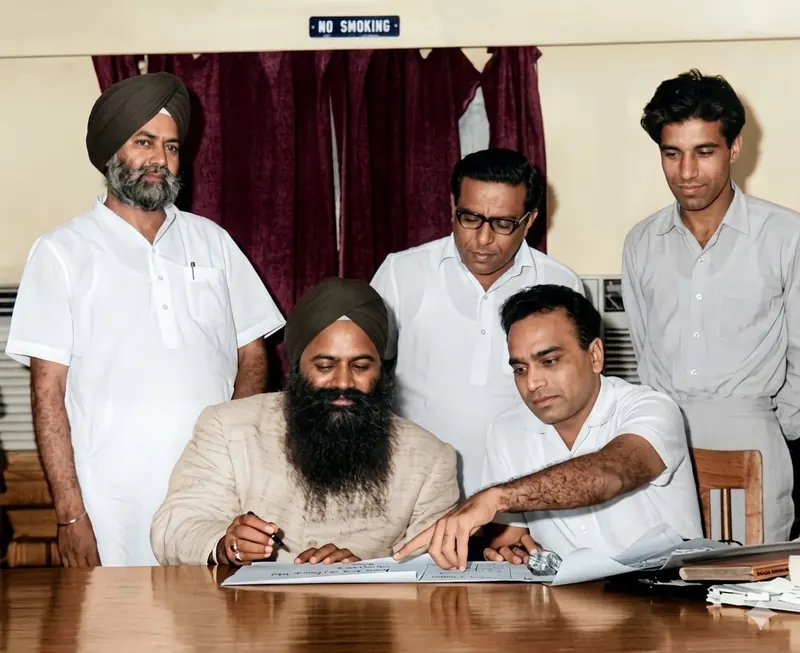
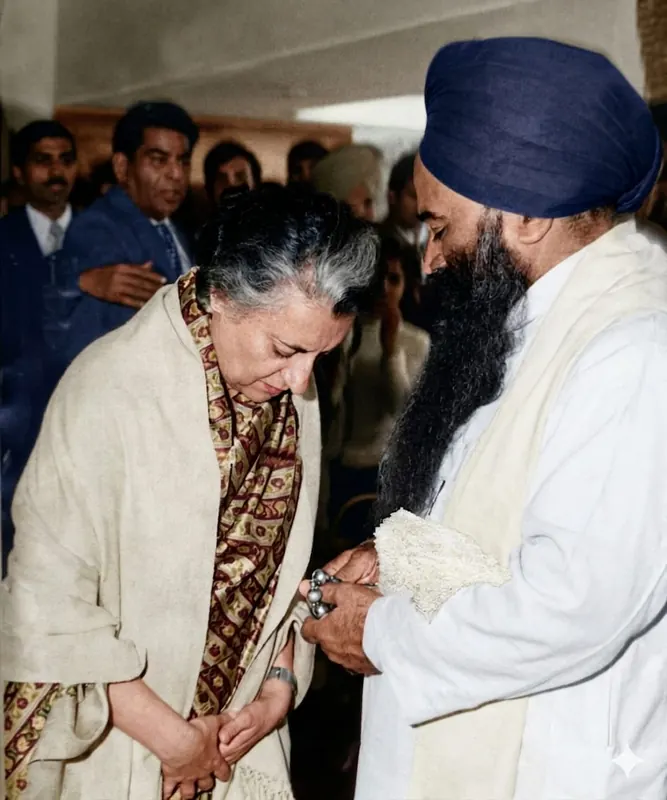
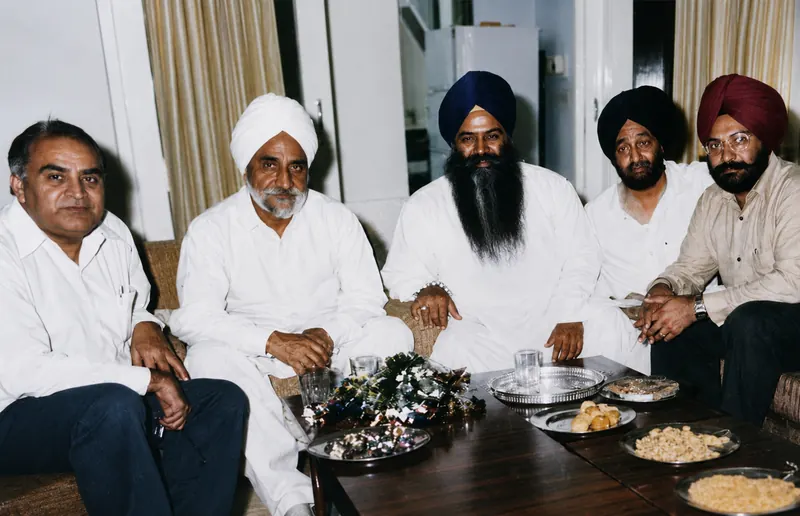
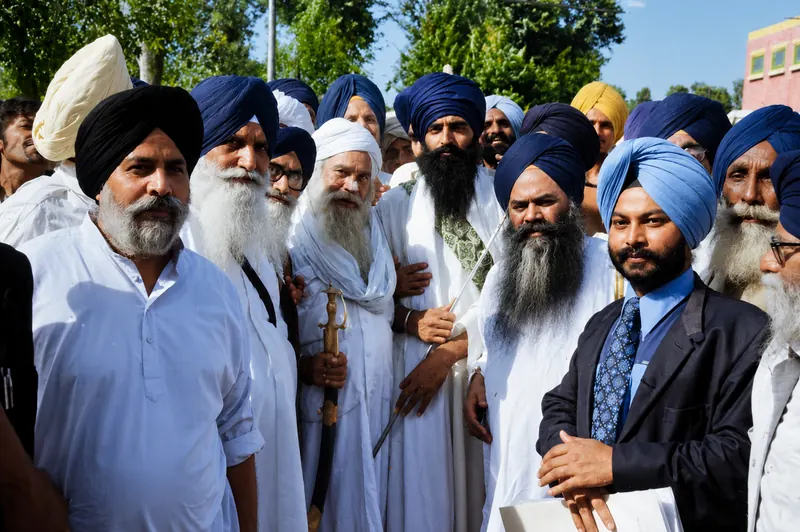
Photographs from a private collection.
v. Timeline
- 1929
Born
20 March, at Kot Badal Khan, Jalandhar district. Named Ram Lubhaya.
- 1942
Quit India
Caught planning to set off a bomb outside the village, and released with a warning. His father withdrew him from school and sent him to learn tailoring.
- c. 1942
Amrit
Received amrit at about twelve or thirteen. Ram Lubhaya became Santokh Singh.
- 1945
Marriage
Married Bibi Satya Kaur of Bagrian.
- 1946
Lahore
Ran his tailoring shop in Dharampura as an Akali election office during the provincial and SGPC elections.
- 1947
Partition
Brought home from Lahore, he organised the defence of Sikh and Hindu families around Nurmahal.
- 1948
Delhi
Reached the city on 7 January and began business on Nai Sarak.
- 1949
The banned conference
The government banned an Akali conference at Rakab Ganj Sahib and arrested Master Tara Singh at Narela. Santokh Singh's slogans there brought him to the notice of senior leaders.
- 1951
Chandni Chowk
Became head of the Chandni Chowk Akali jatha.
- 1955
Punjabi Suba morcha
Led a Delhi jatha after the slogan Punjabi Suba Zindabad was banned. Imprisoned at Ferozepur, he refused to give a false statement to secure release and served the full sentence.
- 1956
Jathedar of the Delhi Akali Dal
Chosen unanimously, at twenty-seven, and entered the Shiromani Akali Dal working committee.
- 1959
Resignation, and election
Resigned the Delhi jathedarship on 22 February after differences with the high command. Elected that year for the first time to the Gurdwara Management Committee, Delhi State.
- 1962
Secretary of the gurdwara committee
Elected unanimously on 10 October, an office he held for nine years.
- 1964
Paonta Sahib
After police firing on 22 May killed eleven Nihang Sikhs, he visited the wounded and brought a Delhi jatha, then fought in court to recover the shrine's alienated land.
- 1965
Guru Harkrishan Public School
Opened at India Gate — Delhi's first Sikh English-medium public school. Ten had been founded by his death.
- 1965
The historic shastars
Asked Prime Minister Lal Bahadur Shastri to secure the return of Guru Gobind Singh Ji's shastars, held in Britain, when Shastri came to Bangla Sahib after the war with Pakistan — General J. N. Chaudhuri and Lieutenant General Harbaksh Singh with him. They arrived within Shastri's lifetime, by special flight into Palam, where he received them with Shastri, Advocate Bakshi Gurcharan Singh, Jathedar Avtar Singh Kohli and Sardar Bahadur Ujjal Singh. They went to Takht Sri Kesgarh Sahib.
- 1966
Manchester
Organised a Delhi action on 6 April supporting Sikh bus workers barred from wearing the turban. Manchester lifted its ban that October by 71 votes to 23.
- 1967
Mata Sundri College for Women
Established beside the gurdwara, on land recovered after a dispute settled by Nehru. He served two terms as its chairman, to July 1971.
- 1967
Gurdwara Bagmari
After an attempt to burn the Calcutta gurdwara, he travelled there, returned, and led an eleven-person hunger strike outside Bangla Sahib.
- 1967–69
Wolverhampton
Organised the march to the British High Commission in Delhi — attendance estimated at 50,000 — in support of Sikh bus drivers contesting a ban on the dastaar. The ban fell in April 1969.
- 1968
Birmingham
Convened a conference to bring British Sikh organisations under one umbrella, and brought four divided groups into a common body.
- 1968
The Kotwali
Petitioned the Lieutenant Governor on 3 February; the announcement came on 2 May; the commemorative stone was laid and two barracks handed over on 11 October. The last portion passed to the committee in 1983.
- 1969
The garland
Honoured by the sangat with ₹110,000 in currency notes for recovering the Kotwali. He handed it over and asked a friend to find him a house; they bought a half-built one for ₹108,000.
- 1969
U.P. Sikh Representative Board
Appointed director for resolving Sikh issues at the Lakhimpur conference.
- 1971
The Sis Ganj morcha
Control of the gurdwara passed to opponents in May. He led the morcha to recover it, was imprisoned on 15 August, and was released on 3 December.
- 1971
Delhi High Court
A judgment identifies him as a party to litigation involving the Delhi Sikh Gurdwara Management Committee, documenting his position in its leadership.
- 1975
A record victory, and a bar
His slate swept the first elections under the Delhi Sikh Gurdwaras Act. Section 10 of the Act barred him from office for want of a matriculation certificate; the elected members made him party leader unanimously instead.
- 1975
Vasant Vihar
A second Guru Harkrishan Public School opened on 9.75 acres provided by the Delhi administration.
- 1977
Sardar-e-Azam
Took up the leadership of the Bir Khalsa Dal after Master Tara Singh's death and set about reviving its scattered units.
- 1977
A brother's family
After Surinder Singh died in a road accident, Santokh Singh took in his widow and three children. The household said it was seven brothers, not four.
- 1980
Indira Gandhi's return to power
After the January general election returned her to office, she came to his home to thank him.
- 1980
Chief Minister of Punjab
He secured Darbara Singh's appointment, putting the case to Indira Gandhi. Darbara Singh was sworn in on 6 June.
- 1980
The Jalandhar address
Delivered a charter of Sikh demands as party president at a conference late in the year — identity, the gurdwaras left across the border, Sikh representation in the forces, Punjabi's status in six states, Chandigarh.
- 1981
The Akal Takht
Summoned over eleven or twelve allegations and advised not to go, he boarded the Frontier Mail, ignored a message telling him to turn back, and presented himself.
- 1981
Chowk Mehta and Ferozepur
Among the Sikh leaders at Chowk Mehta on 20 September when Sant Jarnail Singh Bhindranwale surrendered, and outside Central Jail, Ferozepur, on 15 October when he walked free.
- 1981
Assassinated
Shot on the night of 21 December, as he left the gurdwara at Khiala in west Delhi where he had addressed the congregation. He was fifty-two, and president of the Delhi Sikh Gurdwara Management Committee.
- 1982
Kiratpur Sahib
The ashes went from Delhi in a procession of 125 buses, with state honours from three governments. The final ardas was at Gurdwara Rakab Ganj Sahib on 3 January.
vi. Sources
Claims on this page are referenced in the notes below. Where a claim is attested both by the family's own volume and by a source unconnected to it, the entry is marked corroborated.
-
The book
Sardar-e-Azam Jathedar Santokh Singh, ed. S. Jaswant Singh 'Ajit' and Dr Harbans Kaur Sagoo. Delhi: Manpreet Parkashan, first edition 2017. A commemorative volume in Punjabi by his colleagues, contemporaries and family, in twenty-eight contributions. Much of the biography above draws on it, and the notes name the contributor and, where the volume gives one, the family informant.
bagchee.com -
Statute
The Delhi Sikh Gurdwaras Act, 1971 (Act No. 82 of 1971). Section 10 sets the educational qualification for office-bearers that barred him from the presidency after 1975.
indiacode.nic.in (PDF) -
Death corroborated
Contemporaneous wire report of the shooting, 22 December 1981, giving his title as president of Delhi's Sikh shrine management committee.
UPI Archives -
Britain corroborated
Names him as organiser of the 50,000-strong Delhi march to the British High Commission during the Wolverhampton turban campaign, and of the 1968 Birmingham conference of British Sikh organisations.
South Asian Britain: Connecting Histories -
Manchester
The Manchester and Wolverhampton turban campaigns, their separate chronologies, and the October 1966 committee vote of 71–23.
Global Nonviolent Action Database, Swarthmore -
Ferozepur corroborated
Contemporaneous report of the release, 16 October 1981. Names him as Delhi Gurdwara Parbandhak Committee president, present outside the jail, telling reporters that it was his effort at Delhi that secured the Sant's freedom.
Hindustan Times, HT This Day -
Punjab corroborated
Names him as head of the Delhi gurdwara committee among those who reached Chowk Mehta for Bhindranwale's surrender on 20 September 1981. Ramesh Inder Singh, former Chief Secretary of Punjab, excerpted from Turmoil in Punjab.
babushahi.com -
Court corroborated
1971 Delhi High Court judgment naming him a party to Delhi Gurdwara Parbandhak Committee litigation.
indiankanoon.org -
College
Roll of chairmen, Mata Sundri College for Women — his terms of 1967–70 and 1970–71.
mscw.ac.in — souvenir (PDF) -
School corroborated
Named among the founders of Guru Harkrishan Public School, the first of which was founded at India Gate on 19 July 1965.
thepatriot.in
A note on names
One body appears in this record under several names. It was the Gurdwara Management Committee, Delhi State when he was elected to it in 1959 and became its secretary in 1962. The Delhi Sikh Gurdwaras Act of 1971 constituted it as the Delhi Sikh Gurdwara Management Committee — commonly the DSGMC — which has been its legal name since the Act commenced in April 1972, and is the name used here. The 1971 High Court judgment and the press reports of 1981 call it the Delhi Gurdwara Parbandhak Committee, and that wording is kept where those sources are quoted. These are one institution, not several.
It should not be confused with the Shiromani Gurdwara Parbandhak Committee, the SGPC, which administers the gurdwaras of Punjab.
He was born Ram Lubhaya and took the name Santokh Singh on receiving amrit at about twelve or thirteen. Jathedar is an office he was first elected to in 1956, and Sardar-e-Azam the title he held in the Bir Khalsa Dal from 1977; both are retained here as the record and his contemporaries used them.
vii. Notes
SAJSS is Sardar-e-Azam Jathedar Santokh Singh (2017). Chapter authorship is given, and where the volume names the family member who supplied an account, so is that.
- Sagoo, SAJSS ch. 3, from the account of his sister Bachan Kaur. ↩
- Sagoo, ch. 3. Date of birth from the volume's bibliographic record and Jaswant Singh 'Ajit', ch. 20. ↩
- Sagoo, ch. 3, from the account of his sister Sohan Devi. ↩
- Sagoo, ch. 3 and ch. 4; confirmed to the editors by Gyan Singh, brother of Bibi Satya Kaur. ↩
- Sagoo, ch. 3; Pahwa, ch. 7. ↩
- Sagoo, ch. 26, from the account of his son Harjit Singh. ↩
- Sagoo, ch. 3. ↩
- Pahwa, ch. 7; Jaswant Singh 'Ajit', ch. 20. ↩
- Sagoo, ch. 3. ↩
- Sagoo, ch. 3; Jaswant Singh 'Ajit', ch. 20. ↩
- Pahwa, ch. 7. The volume is not consistent on his first associate in Delhi, and ch. 20 dates the arrival to late 1948. ↩
- Pahwa, ch. 7; Jaswant Singh 'Ajit', ch. 20. ↩
- Jaswant Singh 'Ajit', ch. 20. ↩
- Jaswant Singh 'Ajit', ch. 20, quoting Avtar Singh Kohli. ↩
- Pahwa, ch. 7; Jaswant Singh 'Ajit', ch. 20. ↩
- Pahwa, ch. 7. ↩
- Pahwa, ch. 7; Jaswant Singh 'Ajit', ch. 20. The two accounts name the outgoing secretary differently. ↩
- Sagoo, ch. 5; Jaswant Singh 'Ajit', ch. 20; the addresses of honour reproduced at ch. 27, two of which are directed to him as secretary. ↩
- Sagoo, ch. 5; and ch. 26, from the account of Harjit Singh. ↩
- Manjit Singh G.K., recorded messages to the family, 21–22 August 2026. He names the grantee as Dhirendra Brahmachari's Yog Ashram and dates the recovery to 1969. The account previously given here placed the reversal before Nehru, who died in May 1964. ↩
- Manjit Singh G.K., recorded messages to the family, 21–22 August 2026. ↩
- Manjit Singh G.K., recorded messages to the family, 21–22 August 2026, dating the nail to 1966 and the recovery two years later. ↩
- Sagoo, ch. 26, from the account of Manjit Singh G.K. ↩
- Sagoo, ch. 26, from the account of Manjit Singh G.K. ↩
- Sagoo, ch. 26, from the account of Balbir Singh Kohli. ↩
- Minhas, ch. 6. ↩
- Sagoo, ch. 4 and ch. 26, from the account of Manjit Singh G.K. ↩
- Sagoo, ch. 26, from the account of Harjit Singh. ↩
- Manjit Singh G.K., recorded messages to the family, 21–22 August 2026. He places the meeting with Nehru in 1962–63, in what was then the Ministry of Works and Housing, and gives the present figure as more than eight thousand, approximately. ↩
- Roll of chairmen, Mata Sundri College for Women. ↩
- Sagoo, ch. 26, from the accounts of Rajinder Singh Rajan and Kulwant Singh Dhapri. ↩
- Manjit Singh G.K., recorded messages to the family, 21–22 August 2026, who says he holds a photograph of the visit. ↩
- Manjit Singh G.K., recorded messages to the family, 21–22 August 2026. ↩
- Delhi action of 6 April 1966: Pahwa, ch. 7. The Manchester campaign and the October 1966 vote: Global Nonviolent Action Database. ↩
- The march and the Birmingham conference: South Asian Britain: Connecting Histories, which names him as organiser of both and gives the 50,000 figure. Four groups brought into one body: Pahwa, ch. 7. Sandhu's suspension, Jolly's threat and the April 1969 reversal: Global Nonviolent Action Database. ↩
- Sagoo, ch. 26, from the account of Manjit Singh G.K. ↩
- Pahwa, ch. 7; Jaswant Singh 'Ajit', ch. 20. ↩
- The Delhi Sikh Gurdwaras Act, 1971, s. 10. Enacted 30 December 1971; commenced 7 April 1972. ↩
- Jaswant Singh 'Ajit', ch. 20. ↩
- Manjit Singh G.K., recorded messages to the family, 21–22 August 2026. ↩
- Kapur Singh, ch. 19; quoted in Jaswant Singh 'Ajit', ch. 20. ↩
- Jaswant Singh 'Ajit', ch. 20; addresses of honour, ch. 27. ↩
- Pahwa, ch. 7, from the account of Manjit Singh G.K. ↩
- Jaswant Singh 'Ajit', ch. 20, quoting the Jalandhar address. ↩
- Pahwa, ch. 7. ↩
- Hindustan Times, 16 October 1981; Pahwa, ch. 7; Ramesh Inder Singh, Turmoil in Punjab. ↩
- Sagoo, ch. 26, from the account of Avtar Singh Autopin. ↩
- Sagoo, ch. 4, from the account of Manjit Singh G.K. ↩
- Manjit Singh G.K., recorded messages to the family, 21–22 August 2026, correcting an earlier reading on which the bodyguard was among the dead. ↩
- UPI wire report, 22 December 1981. The volume and the wire report name the assailant differently, and Manjit Singh G.K. gives the name as Sohan Singh Sandhu. The accounts do not agree, and he is not named here. ↩
- Sagoo, ch. 4 and ch. 26, from the account of Harjit Singh. ↩
- Sagoo, ch. 4. ↩
- Sagoo, ch. 4. ↩